Wireless Speakers with LED Lights: A UK Buyer's Guide
Choose a wireless speaker with LED lights by checking sound, Bluetooth and AUX connections, light controls, battery claims and safe listening before buying.
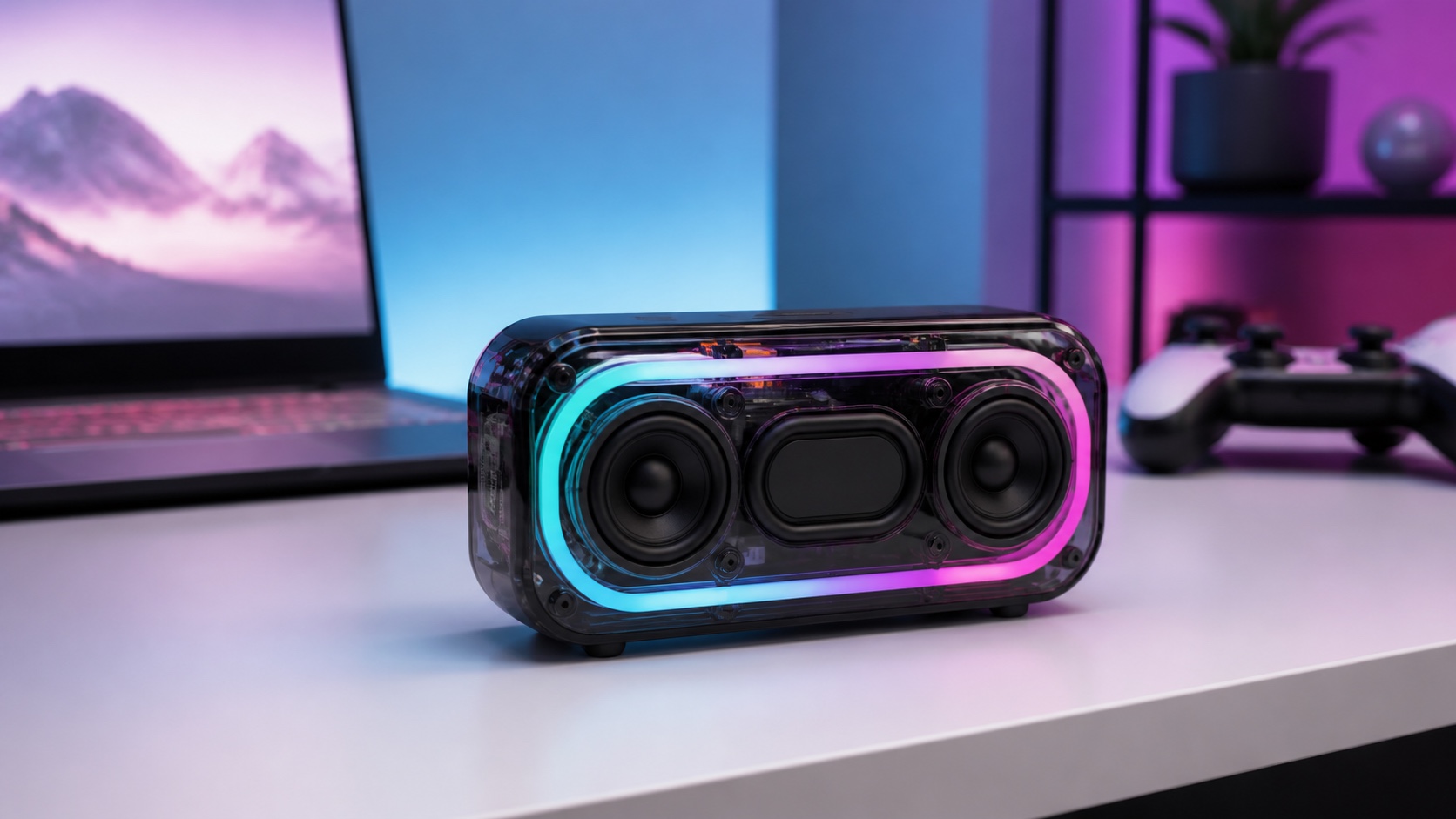
A wireless speaker with LED lights has two jobs, and both should work independently: it should play audio cleanly at the volume you use, and its lighting should improve the room rather than becoming an unavoidable distraction. Buy by connection, controls and use case, not by the brightest product photo.
For most UK buyers, the useful shortlist is simple. Look for stable Bluetooth, a wired input if gaming latency matters, lights that can dim or switch off, a stated lights-on battery figure, and a clear return route. Everything else is secondary.
Start with the job
The same light-up speaker can be a good fit for one room and a poor fit for another.
- Gaming desk: prioritise AUX or another wired input, physical volume controls and a light mode that does not reflect in the monitor.
- Bedroom: require dimming and a full lights-off option. A flashing mode should never be the only choice.
- Small gathering: check usable volume, battery life with lighting enabled and whether two units can form a stereo pair.
- Streaming backdrop: use steady or slow-changing colours that do not upset camera exposure and white balance.
- Travel: weight, charging cable, protective rating and battery rules matter more than peak brightness.
Write one sentence describing the job before comparing models. It prevents a decorative product from winning when you actually need a TV soundbar, waterproof outdoor speaker or accurate desktop monitors.
Connections: Bluetooth convenience versus wired timing
Bluetooth is convenient for music, podcasts and casual video. It also introduces encoding and buffering delay, which varies by phone, computer, codec and speaker. A version number alone does not guarantee imperceptible gaming latency.
For rhythm games, competitive shooters or live monitoring, a 3.5 mm AUX input is the safer testable route when both devices support it. Set the speaker to wired mode, lower system volume before connecting, and then raise it gradually. If a listing says “gaming” but provides no low-latency mode or wired input, treat gaming as styling rather than a measured capability.
For Bluetooth use, verify pairing recovery as well as first pairing. Switch the speaker off, remove it from the phone’s remembered devices, and pair again. A product that only behaves after repeated resets will be annoying long after the lights stop feeling novel.
LED controls that matter
Count controllable behaviours, not advertised colours. A useful speaker should answer these questions:
- Can the lights switch off while audio continues?
- Can brightness be reduced without lowering volume?
- Is there a steady colour or slow ambient mode?
- Does music-sync react at ordinary listening volume?
- Are settings retained after power-off?
- Can modes be changed without a compulsory app?
Fast flashing can be uncomfortable or unsuitable for some people. If photosensitive reactions are a concern, avoid strobe modes and follow relevant medical advice. For camera use, a steady mode is easier to manage than rapid pulse effects. The site’s guide to syncing LED speaker lights to music covers setup, while the RGB desk guide focuses on placement.
Sound before spectacle
Driver count and wattage do not tell you tonal balance, distortion or bass extension. Listen at the volume you actually use and compare speech, a familiar vocal track and a bass-heavy track. Check whether the cabinet rattles, voices become sharp, or bass disappears at lower volume.
A small portable speaker can improve a laptop or phone, but it is not automatically a soundbar or hi-fi replacement. Stereo separation from one compact enclosure is limited. True wireless stereo pairing can widen the image, but it requires two compatible units and more charging.
Keep the speaker on a stable surface with space around passive radiators and controls. Pushing it into a corner can exaggerate bass and make a fair comparison difficult.
Battery claims need two numbers
Lighting consumes power, so the useful comparison is runtime with lights on and lights off. Manufacturer figures are normally measured under particular volume and lighting conditions. They are ceilings, not a guarantee for maximum volume and maximum brightness together.
During the return period, start from a full charge and record:
- connection type;
- approximate volume;
- lighting mode and brightness;
- start and stop times;
- whether low-battery behaviour changes audio or lights.
Use the supplied or correctly specified charging cable and power source. Do not cover the speaker while charging, and stop using a battery product that swells, smells unusual or becomes abnormally hot.
A current on-site example
The site’s NeonPulse product page listed the speaker at £34.99 including VAT when this article was refreshed. Its merchant specifications state Bluetooth 5.3, dual 10 W drivers, a 3600 mAh battery, six RGB modes, USB-C charging, up to 12 hours with lights off and eight hours with lights on, plus 205 x 85 x 85 mm dimensions and a 650 g weight.
Those are product-page claims, not independent laboratory results. Recheck the live page and basket before ordering. The useful parts are the testable differences: separate lights-on runtime, physical size, lights-off control, wired-input support and a 30-day return route. Do not treat order counters or a crossed-out price as evidence of sound quality.
The LED Bluetooth speaker explainer provides another way to compare the category without assuming this model is right for everyone.
A 20-minute acceptance test
Complete this before discarding packaging:
- Inspect the charging port, cable and cabinet for damage.
- Pair by Bluetooth and play speech at low volume.
- Walk to the normal listening position and check for drop-outs.
- Cycle every lighting mode, including dim and off.
- Try AUX with a game or video if timing matters.
- Test the controls without touching the phone.
- Confirm charging and low-battery indicators match the manual.
- Check the returns terms while the deadline is still distant.
Common buying mistakes
- Choosing by RGB brightness while ignoring audio at ordinary volume.
- Assuming a newer Bluetooth version guarantees no gaming delay.
- Comparing lights-off battery claims with lights-on use.
- Buying one compact unit and expecting wide stereo separation.
- Paying for waterproof use when no verified IP rating is published.
- Assuming app control exists when only physical modes are provided.
- Leaving strobe lighting enabled in a bedroom or on camera without testing comfort.
FAQ
Can the LEDs work without music?
It depends on the model. Look for a steady ambient mode and verify it during the return period. Music-sync alone is not the same feature.
Can I switch the lights off?
Require an explicit lights-off control if the speaker will be used for sleep, calls or focused work. The current NeonPulse listing says its lights can be switched off.
Is Bluetooth good enough for gaming?
It is often fine for casual play, but delay varies. Use AUX or a verified low-latency path when timing affects play.
Does 20 W guarantee better sound?
No. Wattage does not describe tuning, distortion, bass extension or room interaction. Listen at your real volume.
What should I compare at checkout?
Compare the final VAT-inclusive price, included cable, warranty provider, return deadline and delivery terms, then save the exact listing you relied on.